
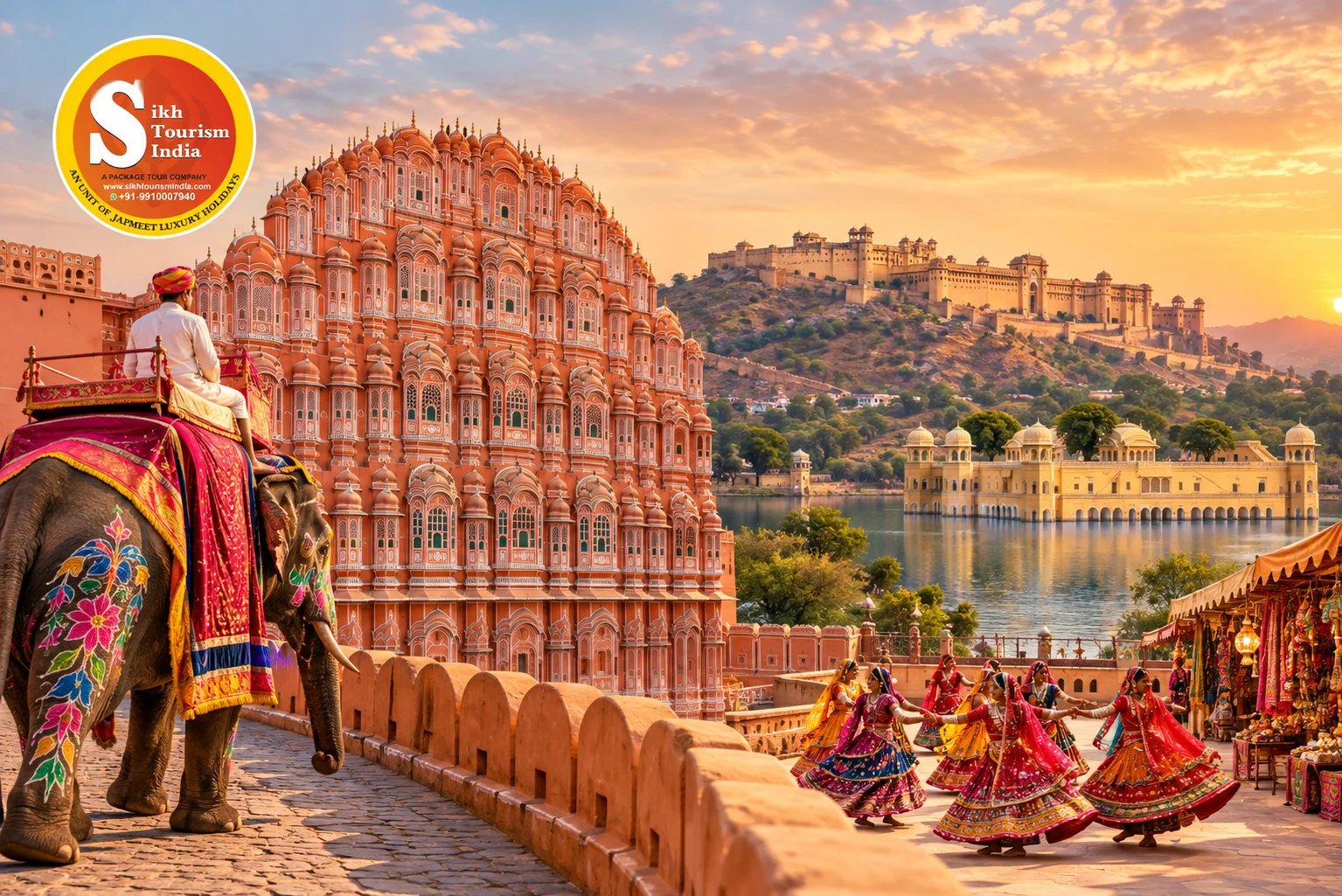
Our drivers in Jaipur call it the pink city like everyone else, then laugh when guests see the walls, which are closer to rust than rose. The colours of Rajasthan tend to surprise people that way, because the nicknames were never meant to be exact. None came off a paint chart. They’re history, trade and faith, set down in stone, lime and a little royal vanity.
The pink city Jaipur is the best example. Founded on 18 November 1727, it was painted for a royal visit in 1876 and still repainted by law, nearly 150 years later.
This Rajasthan travel guide is crafted around the tales of colour. Whether you are planning a short Rajasthan tour from Delhi or comparing the best Rajasthan tour package from the USA, Canada, the UK or Europe, it covers the story behind each nickname, Jaipur’s festival year, the lesser-known colour cities, a season-by-season planner and practical tips for international travellers.
How Each Rajasthan Colour Began
City nicknames stem from three clear sources. Sandstone. Wall wash. Royal decree. The tradition dictating the colours of Rajasthan relies entirely on these elements.
| City | Colour | Source of colour | Founded |
| Jaipur | Pink | Painted wash | 1727 |
| Jodhpur | Blue | Indigo-lime wash | 1459 |
| Jaisalmer | Golden | Yellow sandstone | 1156 |
| Udaipur | White | Marble and lime plaster | 1559 |
| Bikaner | Red | Red sandstone | 1488 |
| Mandawa | Painted | Frescoes | mid-1700s |
A well-planned Rajasthan Tour Package can string all six together in a single road loop, and we map that route later in this guide.
Two entries confuse people online. The blue city Jodhpur and the red city of Rajasthan get mixed up constantly. Readers wondering which city is known as the Purple City usually mean Bikaner too.
Now for a quick myth-buster. No official black city of Rajasthan exists anywhere. Quiz websites invent it constantly, but RTDC materials ignore the idea entirely.
Why Jaipur Is Called Pink City
The 1876 Royal Welcome
Maharaja Sawai Ram Singh II ordered the walled city painted for Albert Edward, Prince of Wales, in 1876. Travel websites often blame Prince Albert. That is historically wrong. Albert Hall’s foundation stone went down on that trip, and the museum opened in 1887. The paint never went west. There is no pink city, Jodhpur, despite what lazy photo captions suggest.
Paint by Law
Let us clarify the exact Rajasthan colour. It is a terracotta tone. You mix geru with lime to get it. No candy tones exist here. Strict building rules mandate this shade inside the walled city today. UNESCO awarded it World Heritage status in July 2019.
A City on a Grid
Architect Vidyadhar Bhattacharya mapped Jaipur on a nine-block grid pulled directly from Vastu Shastra. Two central blocks house the City Palace. Main bazaars span roughly 33 m wide. That is unusually broad for an 18th-century Indian settlement.
Pink City Jaipur, Up Close
Knowing why Jaipur is called the Pink City marks just the beginning. Most visitors snap the same three facades. We often see people ignore the brilliant details right under their noses.
Hawa Mahal’s 953 Windows
Maharaja Sawai Pratap Singh commissioned it in 1799. Lal Chand Ustad designed it. Five storeys hold 953 jharokhas, yet the building is barely one room deep. Here is the hidden detail. You cannot enter from the main street. Visitors walk around to the City Palace side. Royal women used it to watch street processions unobserved. Those tiny windows generate a superb natural cross-breeze.
Jantar Mantar’s Sun Clock
Sawai Jai Singh II finished it around 1734. The site features 19 astronomical instruments. The mammoth Samrat Yantra measures about 27 m tall. It tracks local time down to a two-second margin. It earned UNESCO status in 2010.
Amer, a Hill Fort
UNESCO listed Amer in 2013 among six Hill Forts of Rajasthan. The others include Chittorgarh, Kumbhalgarh, Ranthambore, Gagron and Jaisalmer. Inside, the Sheesh Mahal mirror ceiling reflects a single candle to light the entire room. Take the jeep ascent. Skip the elephant ride.
Jaipur’s Festival Calendar
Festivals pull the colours of Rajasthan off the walls. They spill onto turbans, leheriya saris and paper kites. Timing a Rajasthan Holiday Package around one of them is the easiest way to see the state at full volume.
Annual Festival Timeline:
| When | Festival |
|---|---|
| 14 January | Makar Sankranti kites |
| Late January | Jaipur Literature Festival (JLF) |
| March | Holi |
| March–April | Gangaur |
| July–August | Teej |
| October–November | Diwali |
Kite Day, 14 January
Jaipur’s roofs crowd with people on Makar Sankranti. The sky transforms into a mammoth contest by early afternoon. Paper lanterns float up at night. Weeks prior, markets near Handipura quietly sell glass-coated manjha string.
Gangaur and Teej
Gangaur celebrates Goddess Gauri. Married women pray for their husbands. Unmarried women pray for good matches. The royal procession exits the City Palace through the Zenana Deodhi. Teej arrives with the monsoon rains. Women wear green. Swings hang from trees. Shops sell ghevar. This honeycomb sweet appears almost exclusively now.
JLF
It launched in 2006. It now ranks among the largest free literary festivals globally. Book your room early because it sells out the city.
Flexible dates mean you can time a trip with these events. It is easily the best time to visit Rajasthan for sheer visual overload.
The Craft Behind the Colour
The pink city, Jaipur, displays its traditions openly. Few buyers understand the heavy craft behind them. A good Rajasthan Cultural Tour puts you in the workshop, not just the shop.
Blue Pottery Without Clay
Artisans use quartz powder, powdered glass, multani mitti, borax, and gum. Clay is completely absent. They fire items at low temperatures. Every single piece is fragile and entirely hand-painted. It holds a proud GI tag.
Leheriya and Bandhej
Leheriya translates to wave. Dyers roll cloth diagonally. They tie it and dye it to produce rippling stripes. Bandhej requires thousands of tiny individual knots. These two styles dominate the streets during Teej.
Sanganer and Bagru Prints
Two nearby villages produce two distinct styles. Sanganer craftsmen print fine floral motifs onto bright white backgrounds. Bagru artisans use dabu. That is a heavy mud-resist technique applied with natural dyes on earthy tones. GI tags protect them.Many international guests book a half-day block-printing class here and carry home a scarf they printed themselves.
On the Plate
Expect dal baati churma, pyaaz kachori and sweet ghevar. Ker sangri features desert beans and berries. It started as a desperate famine food. It survives for months in punishing dry weather. Vegetarian and vegan travellers find Rajasthan one of the easiest food regions in the world.
Other Colours of Rajasthan
Jaipur offers merely one shade in a vast palette. Every town below earned its pigment for an entirely different reason.
Blue City Jodhpur
Rao Jodha founded it in 1459. Mehrangarh Fort commands a rocky outcrop roughly 122 m above the plains. Locals debate the blue origins. Brahmin houses. Devotion to Shiva. Heat deflection. Some say copper sulphate in the lime wash stops termites. The bluest alleys hide in Brahmpuri, directly beneath the north face of the fort.
Is There a Pink City Jodhpur?
Let us address the search engine mix-up. Jodhpur’s red-pink sandstone glows intensely at sunset. Online photo captions mislabel it constantly. The official Pink City title belongs to Jaipur alone.
Golden City Jaisalmer
Rawal Jaisal established it on Trikuta Hill in 1156. Sonar Quila features 99 mammoth bastions. It remains a living fort today. Roughly 3,000 to 4,000 residents still live inside. Builders stacked the yellow sandstone blocks largely without mortar. Modern water seepage poses its greatest threat.
White City Udaipur
Maharana Udai Singh II founded it in 1559. Lake Pichola dates back much earlier, to around 1362. The Lake Palace and City Palace dominate the brilliant white skyline.
Ask a passing local “Udaipur, which colour city?” You will receive two answers. White City and City of Lakes. They are equally correct.
Shekhawati Painted Havelis, Mandawa
This region covers Jhunjhunu, Sikar and Churu. Wealthy Marwari merchants funded mammoth frescoes from the mid-1700s to the early 1900s. Later murals depict trains, aeroplanes and British officers. Artists painted them from vague descriptions alone. Lock up your guidebook. A modest caretaker tip of around Rs 50-100 will get you inside most locked doors.
Colour Towns Most Tours Skip
Guidebooks rarely mention these three specific nicknames.
Red City of Rajasthan
Rao Bika founded Bikaner in 1488. Raja Rai Singh built Junagarh Fort between 1589 and 1594 using deep red Dulmera sandstone. Enemy forces never managed to take this major fortress in battle.
Bikaner’s stone takes on a deep magenta hue in the evening light. That answers the question of which city is known as the Purple City in a single glance.
Purple City of Rajasthan
Keep in mind this is an informal travel writer tag. It holds no official government recognition. Sources disagree entirely on its origin.
Places to Stay in Bikaner
Book a heritage haveli deep inside the old town. Or choose a grand palace hotel like Laxmi Niwas. Gajner Palace sits peacefully by its lake 30 km away. Pair this overnight halt with a trip to the NRCC camel farm and the Karni Mata Temple at Deshnoke.
Orange City of Rajasthan
Jhalawar claims this title. Heavy orange orchards surround Bhawani Mandi in the Hadoti region. Gagron Fort stands nearby, proud of its UNESCO status. The fake black city of Rajasthan exists only in digital rumours. Jhalawar rests on a very real, very profitable harvest.
Beyond Colour: Rajasthan Adventure Tour Packages
Not every traveller wants palaces and bazaars alone. Our Rajasthan adventure tour packages add a few days of dust and adrenaline to the heritage route.
- Thar Desert camel safari, Jaisalmer: Ride into the Sam or Khuri dunes at sunset and sleep in a desert camp under clear winter skies.
- Dune bashing by jeep: A fast 4×4 run over the sand near Jaisalmer, usually paired with the camel safari.
- Tiger safari, Ranthambore: Morning and afternoon jeep or canter drives in one of India’s best-known tiger reserves, about 3 to 4 hours from Jaipur.
- Kumbhalgarh wall walk: Hike sections of the fort’s 36 km wall, often called the longest continuous wall in India, on the way between Jodhpur and Udaipur.
- Hot-air balloon over Jaipur: Seasonal early-morning flights over the Amer hills, weather permitting.
Most guests from Europe, Canada and the USA mix two or three of these into a cultural itinerary rather than booking a separate trip.
Places to Visit in Rajasthan
One dedicated road loop easily strings all the colours of Rajasthan together in about two weeks.
Suggested Route Flowchart:
Delhi
⬇
Mandawa (painted, ~255 km)
⬇
Bikaner (red, ~190 km)
⬇
Jaisalmer (golden, ~330 km)
⬇
Jodhpur (blue, ~285 km)
⬇
Udaipur (white, ~260 km)
⬇
Jaipur (pink, ~395 km)
⬇
Agra (~240 km)
⬇
Delhi (~230 km)
Total distance ~ 2,200 km.
Drive north to the Shekhawati painted havelis of Mandawa first. Continue to the heavy stone of the red city of Rajasthan. The pigments deepen aggressively as the desert sand takes over.
The golden city Jaisalmer demands a night inside the fort walls. Then tackle the blue city, Jodhpur. Book a rooftop dinner in Brahmpuri for the absolute best views.
Finish up down south. Sunset on Lake Pichola answers the “Udaipur which colour city” debate perfectly. From there, it is a straight drive back to Jaipur.
Short on time? A 7 to 8 day Jaipur Jodhpur Jaisalmer tour package covers pink, blue and gold, the three colours most first-time visitors come for. Add Udaipur for a 10-day trip, or Delhi and Agra if you are flying in from abroad and want the Taj Mahal too.
Best Time to Visit Rajasthan
Practically every Rajasthan travel guide recommends October to March. The truth involves a bit more nuance.
| Season | Months | Typical day temp | Best for |
| Winter | Oct-Mar | 20-27°C | Forts and desert camps |
| Summer | Apr-Jun | 38-45°C+ | Mount Abu only |
| Monsoon | Jul-Sep | 30-35°C | Lakes and green hills |
The golden city Jaisalmer hosts the Desert Festival in February. It falls exactly on the full moon of Magh.
The white city Udaipur hits its peak during the monsoon. The lakes swell up and the heavy crowds thin out. That suits European travellers on July–August summer holidays.
The orange city of Rajasthan harvests its crop right through winter. You have an excellent reason to drive through the Hadoti region then.
Winter evenings cast long, strange shadows. Bikaner’s stone turns magenta. Writers call it the purple city of Rajasthan for this exact reason.
For travellers from the USA, Canada and Europe, Rajasthan’s best season lines up with Thanksgiving, Christmas and New Year breaks. Late December is the busiest fortnight of the year, so book your Rajasthan Holiday Package 3 to 4 months ahead for those dates. Desert nights in December and January can drop to around 5°C (41°F), so pack a warm layer.
Planning a Rajasthan Tour from the USA, Canada, UK or Europe
Most international guests fly into Delhi, rest a night, and start their Rajasthan tour by road the next morning. Jaipur is about 4 to 5 hours from Delhi on the expressway. Udaipur, Jodhpur and Jaisalmer also have domestic airports if you want to skip a long drive.
| Flying from | Typical flight time to Delhi | India is ahead by |
|---|---|---|
| New York / East Coast USA | ~14–16 hrs (nonstop options) | 9.5–10.5 hrs |
| Toronto | ~13–15 hrs (nonstop options) | 9.5–10.5 hrs |
| Vancouver | ~15–17 hrs | 12.5–13.5 hrs |
| London | ~8.5–9.5 hrs | 4.5–5.5 hrs |
| Frankfurt, Paris, Amsterdam | ~7.5–9 hrs | 3.5–4.5 hrs |
| Moscow | ~6–6.5 hrs | 2.5 hrs |
Flight times are approximate and vary by airline and season. India runs on IST (UTC+5:30) all year with no daylight saving, which is why the gap changes when your clocks change.
Rajasthan Tour Package from the USA (New York and Beyond)
American travellers usually land in Delhi late at night after a long-haul flight. Build in a rest day before Jaipur. A 10 to 14 day Rajasthan tour package from the USA that also includes the Taj Mahal gives the best value for the journey. Many US guests time it with Thanksgiving or the winter break.
Rajasthan Tour from Canada
Canada has one of the largest Indian and Sikh diasporas in the world, so many of our Canadian guests combine a Rajasthan tour from Canada with a family visit to Punjab or a Golden Temple stop in Amritsar. Toronto and Vancouver both have good connections to Delhi.
Rajasthan Holiday Package from the UK and Europe
Travellers from the UK, Germany, France, Italy, Spain and the Netherlands have the shortest flights of any western market. A one-week Rajasthan holiday package works well from Europe, and a two-week loop is comfortable. European guests often ask for heritage hotels, village walks and cooking classes over shopping stops.
Essentials for Foreign Tourists
- Visa: Citizens of the USA, Canada, the UK and most European countries can apply for India’s e-Tourist Visa online. Use only the official government portal, indianvisaonline.gov.in, apply at least 4 days before arrival, and carry a passport valid for 6 months or more. Rules change, so check the portal before you book flights.
- Money: India uses the rupee (INR). Cards work in hotels and larger shops; carry some cash for bazaars, monuments and tips. ATMs are easy to find in every city on this route.
- Dress and etiquette: Cover shoulders and knees at temples. At gurdwaras, cover your head and remove your shoes. Ask before photographing people.
- Health: Buy travel insurance, drink bottled or filtered water, and use strong sunscreen even in winter.
- Phone and internet: An eSIM or a local SIM (bought with your passport) keeps maps and WhatsApp working on the road.
- Getting around: A private Rajasthan tour with driver is the safest and most comfortable way to cover the long distances between cities. Your chauffeur also handles parking, tolls and local directions.
Travel with Sikh Tourism India
You want a ground operator who handles the logistics quietly. We let you experience the colours of Rajasthan instead of fighting traffic. Choose our 14-day Rajasthan Tour Package, a 7 to 8 day Jaipur, Jodhpur and Jaisalmer circuit, or the sharp 7-day Golden Triangle route.
Booking a heritage stay in Bikaner requires local access. So does a 2 am airport pickup. Our team manages it all. We, Sikh Tourism India, are a unit of Japmeet Luxury Holidays Pvt. Ltd. We run Gurudwara tours covering the Golden Temple, Hemkund Sahib, Panj Takht and Manikaran. We also organise Hinduism tours along the Char Dham, Do Dham and specific temple circuits. We also craft India holidays across Kerala, Kashmir and Himachal. Every luxury Rajasthan tour package we plan comes with a fully customised itinerary, direct hotel booking and multilingual guides; tell us your preferred language when you enquire. Chauffeur-driven AC vehicles are standard. Sikh Tourism India runs a high-end luxury fleet of cars and coaches tailored for NRI groups and large families.
Plan your journey with us today via WhatsApp.
Conclusion
Think back to that terracotta wall. The colours of Rajasthan require time. Rushing ruins the experience. See them slowly.
Whether you are planning a Rajasthan Cultural Tour, a desert adventure or a family Rajasthan Holiday Package from abroad, pick your favourite places to visit in Rajasthan and let Sikh Tourism India handle the heavy lifting.
Acronyms Used
AC: Air-Conditioned
GI: Geographical Indication
JLF: Jaipur Literature Festival
NRCC: National Research Centre on Camel
NRI: Non-Resident Indian
RTDC: Rajasthan Tourism Development Corporation
UNESCO: United Nations Educational, Scientific and Cultural Organization
FAQs
1. Is the pink city Jaipur actually pink?
It’s closer to terracotta. As for why Jaipur is called the Pink City, the walled city was painted in 1876 to welcome the Prince of Wales.
2. Why is the blue city Jodhpur blue?
Theories include Brahmin homes, devotion to Shiva, and cooler interiors. There is no pink city Jodhpur; that title is Jaipur’s.
3. Which city is known as the purple city in Rajasthan?
Bikaner, the red city of Rajasthan. Its sandstone looks magenta at dusk, earning it the informal tag purple city of Rajasthan.
4. What are the colours of Rajasthan’s cities?
Jaipur is pink, Jodhpur blue, the golden city Jaisalmer gold, and the white city Udaipur white. Bikaner is red and Jhalawar orange.
5. What is the best time to visit Rajasthan?
October to March is the best time to visit Rajasthan. Allow two weeks to cover the main places to visit in Rajasthan.
6. Which is the best Rajasthan tour package for first-time visitors from abroad?
A 10 to 14 day Rajasthan Tour Package covering Jaipur, Jodhpur, Jaisalmer and Udaipur, with Delhi and Agra at the start or end, gives first-time visitors from the USA, Canada, the UK and Europe the full picture.
7. How many days do I need for a Jaipur Jodhpur Jaisalmer tour?
Plan 7 to 8 days, including one night in a desert camp near Jaisalmer. Add 2 to 3 days for Udaipur.
8. Do US, Canadian, UK and European citizens need a visa for India?
Yes. Most can apply online for India’s e-Tourist Visa at least 4 days before travel through the official portal, indianvisaonline.gov.in.
9. Is Rajasthan safe for foreign tourists?
Rajasthan is one of India’s most visited states by foreign tourists. Use pre-booked transport, a registered tour operator and normal city precautions, and dress modestly at religious sites.
10. Do you offer Rajasthan adventure tour packages?
Yes. Our Rajasthan adventure tour packages can add camel safaris and desert camps in Jaisalmer, a tiger safari in Ranthambore and the Kumbhalgarh wall walk to any cultural itinerary.